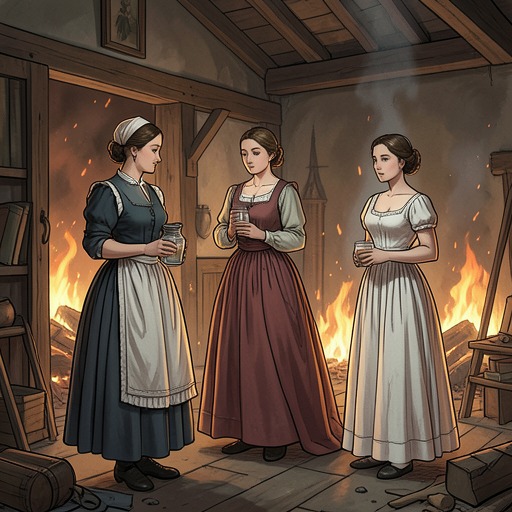
Stefania’s Chamber-Pot Outburst
Felix AustriaStefania’s Chamber-Pot Outburst turns an ordinary household task into a crisis of dignity, anger, and attachment. When Adèle’s demands collide with the work Stefania has already undertaken for her, the servant’s long-contained resentment breaks through in a violent gesture and a desperate accusation; yet even at the height of her anger, Stefania cannot abandon the love that keeps her serving Adèle. The scene exposes the emotional cost of a relationship in which care is constant, recognition is uncertain, and affection does not cancel unequal power.
Background and Immediate Trigger
The confrontation grows out of a history of service and closeness. Stefania and Adèle have been together since childhood, and Stefania has accompanied her even on her honeymoon with Petro. During that trip, Stefania arranged Adèle’s meals, fetched fresh cream, dressed and groomed her, and prepared her bath. Petro’s resentment of Stefania’s presence did not lessen the work she performed or Adèle’s fear of traveling without her.
On the morning of the outburst, Stefania has already been preparing for a gathering. Adèle appears at her bedroom door in a dressing gown, visibly distressed that there is no fresh water and that yesterday’s bread cannot be served. She tells Stefania to go to the bakery, although Stefania points out that someone must also prepare the tench, arrange the salon, and dress and groom Adèle. The immediate dispute is therefore not simply about bread: Adèle’s demand treats Stefania’s other obligations as though they were invisible, while Stefania’s reply makes the accumulated work explicit.
The Outburst on the Stairs
Stefania recalls that she has learned to swallow bitterness rather than prolong their arguments. Earlier quarrels could continue for days, and attempts at reconciliation did not prevent them from starting again. She remembers Adèle calling her a slave, accusing her of stealing Doctor Anger’s watch, and blaming her for attending to household problems instead of Adèle’s appearance. Stefania understands her assigned role as facilitating Adèle’s life, not establishing justice; that discipline has contained her anger without resolving it.
Carrying two chamber pots, Stefania throws them down the stairs. The porcelain does not break, but their contents spill across the floor. Adèle, standing above her, responds with cold composure and says that Madame will be blamed for the flooding. Stefania answers that Adèle should find another servant. Adèle counters that Stefania is not managing her duties properly, turning the exchange back into a dispute over service and competence rather than acknowledging the burden that prompted it.
Anger, Love, and Despair
Facing Adèle, Stefania imagines how easily she could push her down the stairs. The fantasy registers the intensity of her anger, but it does not become an action. When Adèle’s confident expression gives way to fear and tears, Stefania’s hostility is overtaken by tenderness. She recognizes that, despite feeling used and disrespected, she would never harm Adèle. The scene’s emotional reversal is not a reconciliation of their unequal positions; it is Stefania’s recognition that her love persists alongside her resentment.
That recognition does not console her. Stefania feels reduced to a domestic echo: the person who cooks breakfast and deals with Adèle’s chamber pot. For a moment she considers suicide so that Adèle might finally show the response she longs for; she then rejects that course and thinks instead of cutting off her own hair. She rushes downstairs, pulls out her hairpins, and ends up beneath the stairs amid the spilled liquid. Adèle covers her ears and closes her eyes as Stefania screams, then breaks into sobs. The impulses to disappear or alter her appearance express how completely the conflict has turned her pain against herself.
Naming the Invisible Labor
In her outcry, Stefania catalogs the work behind the household’s polished appearance: buying, killing, and cleaning the fish; fetching water; kneading dough and baking bread; waxing the floor; washing heavy curtains; preparing and ironing the tablecloth; dusting rugs and cushions; finding peacock feathers to suit Viennese fashion; cleaning dishes and silver; preparing linseed oil for Adèle’s curls; and lacing her corset late into the night. Stefania contrasts this labor with her own unrepaired stockings and a burned wrist. The inventory gives the argument its force: what had been treated as background service becomes a record of sustained, specific effort.
The speech also connects practical work to Stefania’s need to be valued. Elsewhere, she describes cooking for Adèle and Petro as a form of giving herself, and reads an uneaten meal as a sign that she is unwanted or despised. Her care is neither merely a list of chores nor separate from her affection; it is one of the principal ways she expresses that affection. But the outburst reveals the danger of making service the medium of love when the person serving cannot count on respect in return.
Reconciliation and Continuing Contradictions
Adèle approaches Stefania and tries to comfort her. Her tears fall on Stefania’s burned wrists, and eventually she embraces her. The two cry together until calm and exhaustion settle over them. The immediate confrontation ends in physical closeness rather than a lasting break, but the embrace does not erase the grievance or change the household hierarchy.
Soon afterward, Stefania helps Adèle prepare for guests, dressing and grooming her and arranging a jeweled comb in her hair. The return to service shows how quickly the household’s routines resume after the emotional rupture. Later, Adèle describes Stefania’s upbringing and training as a careful education of a servant, insisting that it must combine discipline with affectionate closeness. That account gives the earlier conflict a wider context: tenderness and control coexist within the same relationship, and the language of intimacy can help maintain the very service structure that Stefania’s protest briefly challenges.
The scene’s significance lies in its refusal to separate devotion from anger. Stefania’s labor sustains Adèle’s comfort and social life, while Stefania’s attachment makes it difficult for her to withdraw that labor even when she feels erased by it. The chamber pots, the spilled contents, and the inventory of chores make visible what the household ordinarily leaves unspoken: service is both material work and an emotionally costly claim to belonging.